A citizen policy proposal · October 2026
From Enforcement to Investment
“You are not under arrest; you are under enrollment.”
ISAE (Immigration Support and Enforcement) is a proposal for people who are already here, pose no public-safety threat, and could be supervised in the community. It does not abolish enforcement. It re-sequences it: verified identity, regular reporting, court tracking and clear obligations for most people, and detention and removal for those who are dangerous, a flight risk, or under an executable final order.
Try the app
The clickable ISAE prototype (made-up sample data) is available on this site. Access is by invitation and requires a password.
The numbers behind the proposal
Learning to be American, together
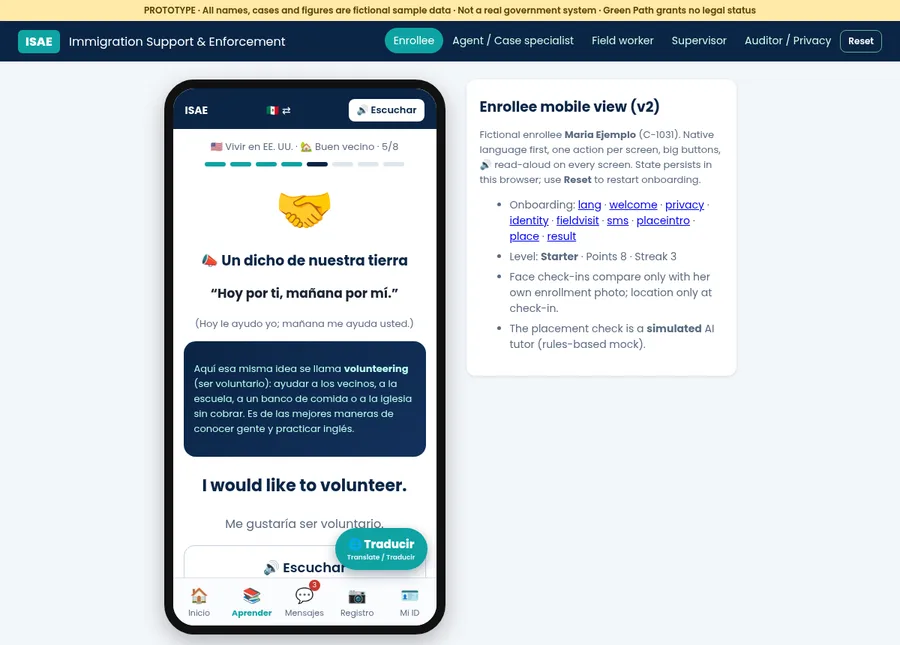
When people hear about ISAE, the part that most often wins them over is not the technology. It is the learning: English, civics, and the everyday know-how most of us picked up growing up and assume everyone knows.
That instinct is widely shared. In a 2024 Pew survey, over three-quarters of U.S. adults said speaking English is key to being “truly” American, and immigrants agreed at the same rate as the U.S.-born (80% and 79%).[6] The National Academies found that immigrants do integrate over time, that integration is a two-way process, and that legal status is a key factor that can slow or block it.[7] ISAE turns that into a concrete, measured program.
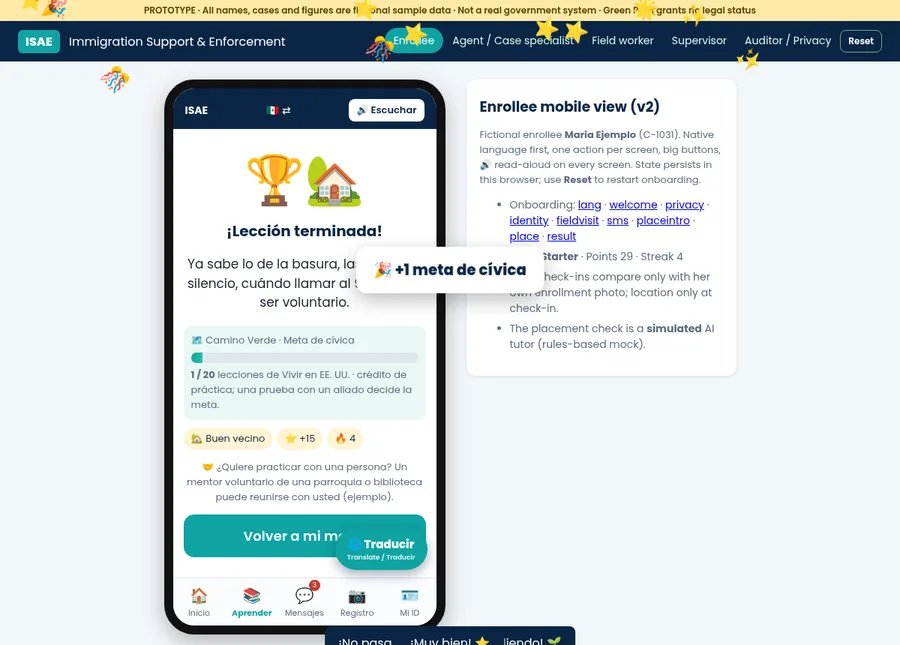
- Living in America lessons: traffic rules, paying taxes, schools and parents’ duties, tenant and workplace rights and safety,[8] when to call 911, trash and recycling, neighbors, punctuality, how local government works, volunteering, and which duties are for citizens only, such as federal jury service.[9]
- Founding ideas and civics from the official USCIS materials.[10] [11]
- In the learner’s own language and culture: written by native-speaker educators, using familiar sayings and examples, in regional varieties, and checked by community reviewers. Indigenous languages use human voices, never machine-only text.
- Real people: volunteer mentors from parishes, adult schools and libraries.
This is civic integration, not erasure: shared rules, rights and responsibilities, with a person’s language, faith and traditions treated as assets. Lessons count toward the Green Path Civics milestone, but a proctored check by a partner, never the app, decides it.
Why now
The United States is operating the largest interior immigration enforcement apparatus in its history. The question is no longer whether the government can spend more on removal. It is whether removal-first spending is the best use of each enforcement dollar and each officer hour.
The costs are not only fiscal. In one week of October 2026 (Oct. 5–11), a local nonprofit counted 75 people taken into custody in Santa Barbara County, 55 of them in Santa Maria. These are unofficial counts reported by the press; no official figures were available.[12] A Westside bakery closed for two mornings.[13] A 65-year-old U.S. citizen in Guadalupe told a reporter, “That was the last day I went to church.”[12]
Families now avoid schools, festivals, businesses, churches and food programs. That trust deficit is a public-safety problem, an economic problem and a moral one, and it is the strongest practical argument for a different model.
This is not happy talk. ISAE would be difficult and controversial. It would need a rigorous pilot, and in the end an act of Congress. But the relevant comparison is not ISAE versus a costless status quo. It is ISAE’s risks, which can be managed and measured, versus the certain costs of continuing on the current course.
Four pillars
1. Economic pivot
Stop paying $187 a day to detain people who are not a threat. Keep and grow the tax base removal destroys.
2. Compliance through incentive
The five-year Green Path rewards hearings attended, a clean record, English, civics and taxes filed.
3. De-escalation triage
Green, yellow, red: a published decision aid. An officer, not an algorithm, makes every decision.
4. Force multiplier
Reminders, check-ins and lessons are automated, so officer time goes to the highest-risk cases.
What ISAE asks for
- A pilot now, inside current law: three to five field offices, independent evaluation and pre-registered public metrics.
- Legislation if the evidence holds: Congress creates ISAE as a successor agency to ICE, with serious-crime enforcement as a smaller, separately accountable unit.
- An earned, conditional path to legal status, decided by Congress, never by executive fiat.
The path from pilot to successor agency Read the hard questions
Get updates
This site will keep changing and growing. Leave your email and we will let you know when there are meaningful changes. Opt-in only.